-
What The Poor Must learn From The Rich Be Rich

The rich get richer and the poor get poorer because of how they think and act. The mindset of the rich is different from that of the average person. The rich person has learned the truth of life. The wealthy individual knows that “life is not for self but for others”, in other words serving other people in the community and creating value in the ecosystem of life, creates wealth and riches. On the other hand, poor people always think that the rich are lucky and blessed. But the truth is that we are all blessed according to our ability. It is what we do with our ability that determines what good comes to us. The mindset of self-preservation and personal happiness is the key drawback for the poor person. They want to meet their immediate needs and wants without thinking about others.
The willingness of rich people to be selflessly confident and determined is the source of their courage in resource acquisition and management. They manage resources with courage, mindlessly seeking to add value to their society rather than their self. This is because they understand that in serving others they meet their own needs and wants. It is in the returns on investment that they find value in luxury.
The rich people have learned to harness the natural and environmental resources that are available to all on earth to create values that benefit everyone in their community and return, the community repays them with cash to continue to add value. This process is called investment, trade and commerce. Therefore, the rich have mastered the management of earth resources, for the good of others and the happiness of the world.
When we know ourselves through meditation on the truth and love for knowledge, with understanding and wisdom, our potential, gifts and talents fit into our world. In this mindset, the rich do not make choices based on the influence of society or their immediate environment. Rather they conjure the image of their world in their mind to bring their wishes to the point of belief and from belief to reality. This positive energy and mindset created by self-knowledge enable the rich to use for free the natural endowments of the earth to build riches either through production or service industry.
Rich people have learned to see opportunities in every need and every crisis. They panic in adversity like everyone, but it does not last. They cry, clean their tears, and open their eyes to see opportunities to make a better world. This is a habit of the rich. Necessity is the mother of invention. Crisis is always present on earth to offer opportunities to those who have developed their mindset to know the truth of life. Crisis is the tool used by the earth and the universe to provide opportunities for change and the creation of wealth.
Change is welcomed and used by the rich to create more wealth. This is why the rich are restless with the acquisition of knowledge and are always seeking to understand what opportunities the new knowledge will offer for them, to create a change and to generate commerce and business growth. Growth is change and progress. The rich have the confidence, determination and courage to seize opportunities and create value for society. The poor are always looking for the reasons for the change that occurred and who to blame. This mindset of looking for excuses for every change that occurs occupies the minds of the poor and stunts growth in positive thinking and making wealth. The poor always play the blame game because they do not understand that the engine of growth is crisis and change. When they obey the principle of multiplication of resources they create new values that change the environment and create opportunities for growth and wealth. This is a clear ignorance of the truth of life.
These qualities of the rich are learned from birth. It begins with the knowledge of core values in life, love, joy, peace, kindness, goodness, diligence, perseverance, gentleness and self-control. It is our choice to learn these core values or to remain ignorant. Unfortunately, they are not taught in the classroom of any institution. They are learned at home and the teachers are the environment, parents, community, social ecosystem, culture and peers. It is within this choice process that all humans are equal. So we have to choose whether we want to be rich or poor by the type of habits we form and embrace. The basis of these two categories of life called rich and poor is a choice of mindset and values. The rich will always choose to invest resources and focus on earning rather than saving while the poor meet their wants with existing resources.
Consequently the rich get richer and the poor get poorer because the poor is always digging a hole that consumes resources while the rich creates more resources to enrich the earth and make it a better place. It is mindsets and understanding of the truth of life. When people steal money and resources they are not rich, because they have not created value. Wealth is the creation of value and the management of earthly resources to bring peace of mind, joy and goodwill to the world. Consequently, the poor will always be with us as long as there are good and bad choices.
-
What To Do Before Starting a Business Venture.

In Nigeria and most of Africa, starting a business can be very stressful and discouraging. Economic activities that yield profits and bring added value to social life in the communities are at the rudimentary stages. Trade by barter is still existing in many rural areas and are now being frustrated by the new social and economic realities driven by technology. Societies have developed their own methods of entrepreneurship that depend on unwritten values and systems. However, with increased levels of education, cultural changes, urbanisation and increased unemployment, there is a rapid change in societal expectations and values that have introduced modern enterprise requirements.
It is significant to note that in post-colonial Africa, many educated people were not trained for business and do not possess the skills for modern business ventures. Consequently, the ways of doing commercial activities have been changing and now demand new skill sets that may not be tangible but are natural and true.
Therefore, to many nascent entrepreneurs in Africa, it often feels like there are insurmountable obstacles to laying a good foundation for business in the communities. This situation may explain why most African entrepreneurs do not venture into enterprise and when they do, they quit when the going is tough and return to paid emplyment or nothing at all.
Starting a business in the African environment is a lot of work, but it is important to note that success is made of sterner stuff. However, there’s no avoiding some basic steps and reality for new small business owners who aspire to grow in future in the present day.
So with simple steps such as Prepare, Form, Fashion and Create, it is possible to develop a business mindset and take actions with a sense of purpose toward building the foundation of a strong business. Often experienced business consultants say to their clients, you must give it all. Giving it all is like directing energy to a blunt axe. When the axe is sharpened then it can add value to the purpose.
The natural first step in starting a business is to be prepared and ready to do something that humanity will use, cherish and appreciate and are willing to give something in return to the entrepreneur or businessman for their efforts. This first step involves being convinced that one can do something useful to make the human community better. The conviction leads to a mindset change that will drive the ability to form the concept that leads to a defined but flexible pattern. This foundation or set out, is forged by continual and dynamic experience as the enterprise is built in the mind of the business starter. Continuous meditation on the concept brings knowledge of the purpose of the business to the mind and strengthens the mindset through communications and linkages with experts and interested parties. This situation change also continually shapes the nature of the industry in the mind and creates the avenue for an appropriate understanding of the legal and financial aspects of the industry operations.
Upon this understanding, the image of the business begins to form in the entrepreneur’s mind and the Fashioning process begins. At this stage, the businessman begins to take inventory of the resources available in the environment that will support the shaping, structuring, fabricating and casting of the foundation of the enterprise. The structure of the enterprise determines the growth process and how far the business can go within the existing legal and financial policies and framework. This image may be blurred at first but will continue to be clear as the mind is transformed daily through the renewal of concept.
Then with a good visualisation of the business shape and structure, available resources can be used to create the business from the foundation to growth. The transformation of the wishes of the entrepreneur, to belief and the belief to reality is driven by an energy source only generated in oneself through thinking, meditation, knowledge, understanding and wisdom. This energy which sets the entrepreneurs apart, can be drawn by anyone who has such self-control to develop the mind to the point of obedience to the Infinite source of all things.
Anyone aiming to start a business venture on this earth must understand that there is a Spirit behind every business, and all entrepreneurs have absolute control of their minds and are obedient to their inner thoughts. The discovery of self is the beginning of wisdom and a successful business venture.
Check out my blog for everything you require to build a strong business with a solid foundation.
-
Science Data Required To Design a Port & Harbour in a Delta Environment.
The dominant route of international commerce is its Harbours and Ports. Through them, cargoes and travellers pass from one part of the globe to another. A Port is where a ship can dock, whereas a Harbour is where ships receive and discharge cargo.
Ports and Harbours are precisely the same. A Port is a harbour town where ships receive or discharge cargo, whereas a Harbour is an area where a ship can dock. Key Harbour components include breakwaters, jetties, entrance channels, berthing basins, piers, and docks. Docks provide a uniform water level for loading and unloading cargo, and wet docks for general cargo or dry docks for ship repairs. Therefore, the design engineer must protect the Harbour from storms and large waves.
Developing a harbour into an economically thriving Port depends upon several primary conditions. Adjoining land areas’ geographical and regional characteristics should be favourable for piers, wharves, loading and unloading facilities, warehouses, population centre development, industries, railroads, and ship repair Harbours. Also, an accessible interior economy that provides products and services for export while providing a market for imported goods. The bottom of the Harbour should offer a good holding ground for anchors—it must not be too rocky, sandy, or muddy. The primary requirements of a good Harbour are that it is open and has sufficient water depth for vessels to enter and exit safely. Ocean Harbours are commonly 40 feet deep or more. The Harbour should also be spacious enough for ships to ride at anchor and to manoeuvre. Currents and tides must not be excessive.
Planning Harbours and Ports for transportation, reclamation, or conservancy has recently included modelling the Harbours, Ports, and surrounding areas to assist with future minor modifications or additions. These enable the design engineers to produce models that allow water flow to mimic the tidal and wave effects of the existing coastline system.
Various types of scientific data are required to design and model a Port and Harbour in a delta environment. It is noteworthy to mention that Fundamental Integrated Site Appraisal Services (FISAS) Limited, with its vast experience in integrated data acquisition in the dynamic and complex ecosystems of the Niger Delta, is a trusted partner for Port and Harbour design.
Some of the critical data requirements collected and interpreted by Fundamental Integrated Site Appraisal Services (FISAS) Limited include:
- Bathymetric data are accurate depth soundings and bathymetric surveys to understand the seafloor topography.
- Hydrographic data includes water level, tide, and current to understand the tidal regime and flow patterns.
- Sediment transport data: Information on sediment types, transport rates, and deposition patterns.
- Geotechnical data consists of Soil and rock properties, strength, stability, and settlement characteristics.
- Environmental data include water quality, salinity, temperature, and other parameters to assess potential environmental impacts.
- Meteorological data comprise Wind, wave, and storm surge data to design for extreme weather conditions.
- Geological data provide information on local geology, including fault lines, subsidence, and seismic activity.
- Oceanographic and metocean data provide information on ocean currents, waves, and water levels that help us understand the marine environment.
- Ecological data includes information on marine life, habitats, and ecosystems to minimise environmental impacts.
- Our topographic data significantly contribute to accurately mapping the surrounding land and coastal areas.
These data are essential for designing a Port that can withstand the dynamic conditions of a delta environment, ensure safe navigation, and minimise environmental impacts. Fundamental Integrated Site Appraisal Services(FISAS) Limited, as a one-stop shop for collecting and interpreting this data, provides the necessary support in the form required by the design Engineers, ensuring an efficient and comprehensive process.vides the necessary support in the form required by the design Engineers, ensuring an efficient and comprehensive process.
-
Discipline Is Vital In Business For Success and Growth In Life.
Discipline is the discipline of making people obey and adhere to standards of behavior and reprimanding them when they fail so that the activity or behavior can become a culture. When we do something consistently, we become better and better every day, and it develops from routine to tradition and then to culture. Therefore, discipline is vital in business for success and growth in life.
An entrepreneur is an individual who identifies a need in the marketplace and works to fulfil it. Historically, the term has been applied to an individual who starts a business, seeing the ability to accomplish that identified need as an economic opportunity. Overall, entrepreneurs possess innate talents that enable them to deal well with complexity and uncertainty, enjoy novelty, and look toward the future. However, entrepreneurship is a skill entrepreneurs can build through experience, accruing knowledge, and practising discipline.
Discipline is essential in entrepreneurship as it helps individuals develop good habits, stay focused, and make sacrifices necessary to achieve their goals. Discipline enables the entrepreneur to acquire the skill of time management as they learn to prioritise tasks, set schedules, and meet deadlines. This skill ensures the business owner sets clear, achievable goals and works towards them.
A key benefit of discipline in entrepreneurship is managing finances effectively, including budgeting, saving, and investing. Entrepreneurs make suitable investments by evaluating risk-taking steps and must have the discipline to weigh options and make informed decisions.
Another significant benefit of business discipline is adaptability and resilience in facing challenges and failures. Accepting failures in the first place is a mark of discipline and the ability to adhere to continuous learning. This ability to stay curious and committed to education and self-improvement is a discipline every progressive entrepreneur must have to maintain resilience and growth.
Similarly, discipline enables the entrepreneur to become accountable, to take responsibility for actions and decisions, and to be responsible to oneself and others. Again, discipline keeps the entrepreneur focused on the organisation’s vision and mission and the period’s goals while avoiding distractions. The body is full of light when the eye is single.
The critical measure of entrepreneur discipline is perseverance, which is the ability to persist through challenges and setbacks and maintain motivation. Although perseverance can be difficult, it shows the entrepreneur’s ability to see challenges as corrective and amelioration tools in business ventures. The most crucial benefit of discipline is self-discipline, which leads to developing self-awareness, self-regulation, and self-motivation to achieve success.
Establishing a culture of discipline can help entrepreneurs increase their chances of success and build a strong business foundation.
-
Though Tribe And Tongue May Differ In Brotherhood We Stand….Nigeria My Country.
Nigeria is in West Africa, with an area of approximately 923,768 square kilometres (356,669 square miles). Nigeria is bordering several countries including Benin, Chad, Cameroon, and Niger with the Capital City in Abuja and the Largest City, Lagos.
The approximate population of Nigeria is 213 million people, (2020 estimate) living in diverse terrain, characterised by tropical rainforests in the south, savannas in the north, and mountains in the east. The highest point in Nigeria is Chappal Waddi, which stands at 2,419 meters (7,936 feet) above sea level.
Nigeria also has several major rivers, such as the Niger River, Benue River, and Cross River, which is thought to be the reason for the migration of several diverse people to the region. Nigeria’s coastline is approximately 853 kilometres (530 miles) along the Gulf of Guinea and is rich in natural resources.
Nigeria has a tropical climate, with two main seasons: the rainy season (April-October) and the dry season (November-March) which supports diverse agriculture. The country is rich in natural resources, including crude oil, natural gas, coal, iron ore, Niobium, Lithium, Gold and tin.
The above geographic features have a significant impact on Nigeria’s diverse culture, economy, and daily life. Nigeria is a culturally rich and diverse country with over 250 ethnic groups, each with a distinct language, culture, and traditions.
Look at this map:
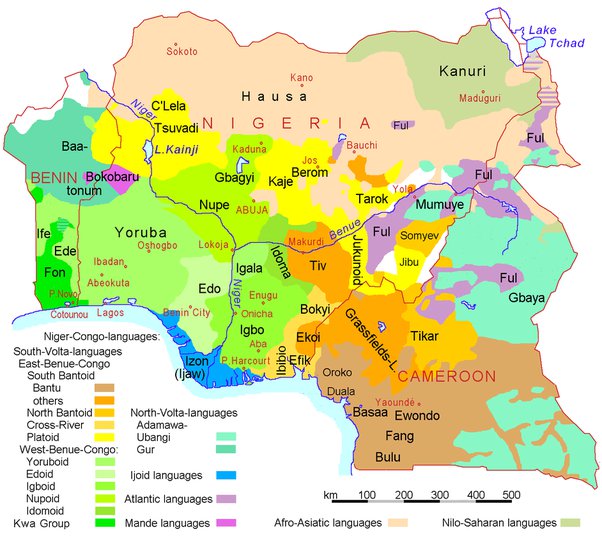
Some of the major tribal groups in Nigeria include; Hausa (29%) predominantly found in the north, Yoruba (21%) mainly in the southwest, Igbo (18%) found in the southeast, Fulani (10%) a nomadic group spread across the country. Others are the Ibibio (4%) in the south, Kanuri (3%) found in the northeast, Edo (2%) mainly in the south, Nupe (2%) found in the central north, Tiv (2%) in the middle belt, and Ijaw (1%) found in the coastal line of Nigeria.
Other notable tribes include the Berom in the Jos plateau, Igala and Idoma, in the middle belt region and Efik, in the south among many others. This diversity has contributed to Nigeria’s rich cultural landscape and heritage.
Nigeria’s tribal diversity has several positive implications such as the cultural wealth associated with over 250 ethnic groups, which boasts a vibrant cultural landscape, showcasing a wide range of languages, customs, and traditions with structured leadership systems that persist.
Tribal diversity fosters strong community bonds, social cohesion, and support networks within and across ethnic groups. Similarly, the diversity of tribes contributes to economic development through entrepreneurship, innovation, and resourcefulness. It encourages competition and creativity in all spheres of life. The federal character principle ensures the representation and inclusion of various ethnic groups in governance and decision-making processes.
Tribal diversity attracts tourists, promoting cultural exchange and enhancing revenue generation. Nigeria’s many languages enrich the country’s linguistic heritage and contribute to global language diversity. Tribal diversity has helped Nigerians adapt to challenges and thrive in a dynamic and harsh environment.
Thus, embracing tribal diversity strengthens Nigerian identity and promotes unity in diversity. Though tribe and tongue may differ in brotherhood Nigerians stand, especially when they meet abroad. The vibrant exchange of Naija salute and discussion has not ceased to amaze the host nations.
Tribal diversity has inspired creativity, driving progress in arts, literature, music, and science. Nigeria’s tribal diversity has served as a model for celebrating and managing diversity worldwide.
By embracing and celebrating its tribal diversity, Nigeria can continue to harness its strengths and promote a more inclusive and vibrant society.
-
Few Nuggets of Wisdom for Enterpreneurs
- Have a vision of your life to develop the provision for creating the reality.
- Allow others to call you a hero, otherwise you are boasting.
- Understand that Life goes on even without you, so keep pushing to make good use of time.
- Do not force anyone to be your friend, or to favour you.
- Learn the art of being alone to meditate on issues of life.
- Learn to stay calm in the face of anger and irritation, you will win favour.
- Patient persuasion breaks down the thickest wall.
- To avoid disappointment, do not expect too much from anyone.
- You need to take people for who they are, not what you want them to be.
- Everyone in a relationship will show you who they are, just give them time.
- Mind your own business and you will be at peace.
-
Nigeria and National Attire: Why Not Have One as a Uniting Force.
Nigeria gained independence from British colonial rule in 1960, and efforts to forge a national identity that would accommodate the diverse ethnic groups within the country marked the post-colonial period.
Nigeria is a culturally diverse country with over 250 ethnic groups, each with its distinct traditions, languages, and clothing styles. The diversity of Nigeria’s population has resulted in an array of traditional attires that vary across regions and ethnic groups. These traditional clothes are deeply rooted in the cultural heritage and history of each ethnic group.
Here are some of the several national attires, including:
- Agbada: a flowing robe worn by men, typically made from cotton or silk.
- Babban riga: a long robe with wide sleeves, worn by men.
- Kaftan: a loose-fitting tunic worn by both men and women.
- Adire, Batik and Ankra: traditional textiles used to make clothing.
- Gele: a headscarf worn by women to cover their hair.
- Aso oke, Akwa Ocha, Akwete and other traditional handwoven cloths worn on special occasions.
These attires are worn on different occasions, such as traditional weddings, cultural events, and formal gatherings. Nigeria’s diverse cultural heritage is reflected in its various traditional attires, which are worn with pride by its citizens.
The absence of a single national cloth for Nigerians can be attributed to the country’s history and the desire to respect and preserve the cultural identities of its various ethnic groups.
Promoting a single national cloth for all Nigerians might be challenging because it might overlook or marginalize the rich cultural heritage of different ethnic groups. Nigeria’s government recognizes the importance of cultural diversity and has sought to celebrate and preserve the traditional attire of each ethnic group rather than imposing a single national attire.
That being said, sometimes Nigerians come together for national events, such as Independence Day celebrations, sports competitions, or official ceremonies, where a unified national dress code may be encouraged or adopted temporarily to foster a sense of unity and pride as Nigerians. The increasing number of intertribal marriages and cross-tribal children supports this phenomenon. More, especially when these intertribal children are growing up to form a critical mass called Naija children. Therefore, having a national attire called “Naija Cloth” does not replace or diminish the significance of the diverse traditional clothing styles that Nigerians proudly wear to identify with their respective ethnic heritage. -
THINKING BEYOND CERTIFICATES AND DEGREES IN ENTREPRENEURSHIP: PART3
A certificate is a document that shows potential employers that someone has completed focused, industry-specific training within the academic setting. A degree is awarded by a college or university to shows potential employers that one has completed significant coursework for a specific area of study. Certificates can be helpful when entering a career field that does not require a degree, and can also be useful when shifting to a new specialization within a familiar industry.
Degrees are offered at the associate, bachelor’s, master’s and doctorate levels. Associate’s and bachelor’s degrees are for entry-level positions in certain industries, and master’s degrees or doctorates may be for executive-level roles or positions in higher education.
The above clarifications call for the understanding of the root and origin of the word ‘education‘ from the Latin root educate. ‘Educare’ means ‘to lead out or bring forth‘. It is an attempt to draw out the best in an individual’s mind and body. In its most literal sense, education means becoming developed from inside to outside. Thus, education is the process of developing the inner abilities of individuals for service to humanity.
Education is, therefore, the process of change and development of the individual. Change is the basic element of the process of education and it includes all those activities that make an individual become a useful member of the society. It also provides a channel for the transmission of human heritage from one generation to another. The systems of education found in global institutions are developed for the training of individual faculties, bureaucracy and enterprise.
Education is naturally, the manifestation of the perfection that already exists in man and is resident in ‘the self’ in man which is a part of universal reality. Leading the self through education makes the individual aware of the power of the mind to a successful life.
Describing education in several other ways, buttress my point on the significance of entrepreneurship education for successful business ventures.
To Aristotle: “Education is the creation of a sound mind in a sound body. It develops man’s faculty, especially his mind so that he may be able to enjoy the contemplation of supreme truth, goodness and beauty of which perfect happiness essentially consists. Albert Einstein said, “Education is not the learning of facts, but the training of the mind to think.”
The above definitions of Education, create a concept in entrepreneurship education that emphasizes the mechanism of setting up, starting, and running a business. It also deals with developing the attitudes, competencies, and behaviours required to function as an entrepreneur within the business and non-business ecosystems.
So, the definition of entrepreneurship education involves three key concepts: seeing opportunities, seizing opportunities, and creating value, it takes entrepreneurial skills to combine these three aspects. In that sense, it can entail creativity and innovation. Seeing and exploiting opportunities is what makes someone enterprising. That attitude can be widely applied.
The notion of entrepreneurship, which involves creating value, relates to running one’s own business. In this way, a company creates value; income, and freedom, for the environment, such as customers, the neighbourhood, and suppliers. It is important to mention that to add value, is much more than just money or income. It is often more about satisfaction and recognition. To be able to create value, an entrepreneurial attitude of being able to see and exploit opportunities (again and again) demands being enterprising.
Being enterprising is an important condition for entrepreneurship and also an umbrella term for entrepreneurial behaviour. Many institutions that award certificates and degrees claim to teach entrepreneurship in the classroom, but the lecturers have no experience in the daily practice of entrepreneurship. This is a problem, especially for learning entrepreneurial behaviour through a certificate or degree programme. The main laboratory for entrepreneurship education is the economy of the nation and the global trade in goods and services. Therefore, entrepreneurial education which develops skills through the change in mindsets, must involve a combination of creativity, flexibility, risk-taking, and perseverance in a continually changing world.
These contemporary skills as part of the Sustainable Development Goals (SDG) are vital, and entrepreneurship and entrepreneurial thinking are now more crucial than ever. But even in larger organizations – public and private – an enterprising mindset plays an essential role. They all play their part in any entrepreneurial ecosystem, with an important role in entrepreneurship and enterprise education.
There is a popular creativity term and concept “Think outside the box” that explains the major reasons why most graduates are not good entrepreneurs. They simply cannot see and think beyond their certificates. Many engineering degree holders work as bankers, and medical doctors with great skills in web and graphic design. Some skilled lawyers are very nimble with finances. The list is endless!
The basic truth of life is that the skills needed to be much sought after and become more successful in life are found outside the walls of the classrooms of the institutions. Certificates and degrees are just proof that you are teachable, it does not suggest what someone can do and their potential and gifts. The earth is full of possibilities when people think beyond their degrees and certificates.
-
DEGREES, CERTIFICATES AND ENTREPRENEURSHIP PART 2
In Africa, enormous technological advancements, corruption, mismanagement of natural resources and population growth have consistently limited job prospects. Entrepreneurship and education have emerged as activities that younger Africans demand. While jobs are limited, entrepreneurship has been considered the most significant career option.
There is no doubt that entrepreneurship is significantly contributing to economic growth in most African countries while generating various job perspectives. Hence, intellectuals constantly encourage and motivate young minds to establish a business of their own.
Whether the dream is a big tech start-up or a plan to take over a family-owned venture, becoming a business owner is a goal to which many would-be entrepreneurs aspire. Just as there are hundreds of types of businesses to own, so are many paths to getting there.
While there are stereotypes of entrepreneurs, there is no significant demographic profile required for launching a successful venture. So, anyone can efficiently succeed as an entrepreneur irrespective of gender, caste, creed, or race. However, there is the need to possess certain business traits and skills, and these including:
- Confidence
- Financial literacy
- Networking
- Knowledge of accepting and acting on feedback
- A growing mindset
- Efficient skills of strategic thinking
Build your entrepreneurial competency — a way of thinking about problem-solving that can be applied across every industry and every type of organization
Therefore, degrees and certificates in Entrepreneurship Skills should aim to develop the business owner’s understanding of the concept and underlying required skill set that sets apart a person as an entrepreneur. The business owner must be able to understand in detail the financial, human, and leadership side of an entrepreneur so that the business owner can garner the ideas and adopt the required skills to become a successful entrepreneur.
Many business owners also provide the services sold in their business. For instance, a doctor may own their clinic and similarly, a mechanical engineer may also own an auto repair shop as well. While it is common for business owners to be involved in their businesses, it is not a mandatory requirement for entrepreneurship. For this reason, there are no set educational requirements that an owner must meet. Being financially and legally responsible for a business does not require a degree certificate from any university or be certified by a licensing agency—in most cases. Having the business skills to own a medical clinic or auto repair shop does not mean that the entrepreneur will provide the services personally. That said, countries often require business owners to be licensed to perform work in specific professions, which may include everything from health professions to agriculture and hairdressing.
Entrepreneurs aim to start, develop, finance, manage, and harvest new ventures with high growth potential and to explore the development of innovative thinking and venture appraisal that could, ultimately, lead to a new business venture. They start by developing a business plan, examining how to formulate practical business ideas, selecting a suitable location, selecting a legal form of organization, locating financing sources, assessing the market, developing a human resource management system, and establishing budgets for control. It is indeed right to say that nobody is truly rich until
From the above analysis of the relationship between entrepreneurship and business ventures, the role of degrees and certificates is limited to facts, and knowledge devoid of understanding and application. The use of knowledge and facts is tied to abilities to seize opportunities and take risks with knowledge and facts to serve humanity. Certificates and degrees prepare graduates to look for jobs rather than opening their eyes to life-changing opportunities. People are not poor because they don’t have a job; they are poor because they are not seeing and seizing opportunities. Being poor is simply passing over opportunities Repeatedly! What keeps people ahead in life is not their education or degrees, it is simply the opportunity that they seized. Jobs may be scarce but not opportunities.
As long as there is a problem to be solved, there will always be opportunities. It is a waste of education, exposure, and experiences if after graduating from school, all we are doing is searching for a job. An enlightened and educated mind should be able to see and seize opportunities and develop a business venture that can efficiently become a successful enterprise while tackling future adversities.
-
THE PLACE OF CERTIFICATES AND DEGREES IN ENTREPRENEURSHIP. PART 1
There are no hard-fast certifications and degree requirements to start a business or to become an entrepreneur. An MBA, bachelor’s, associate’s, or master’s degree enables a strong foundation that benefits a career and helps earning potential rather than promoting entrepreneurship. Academic programs help learn facts, know where to find knowledge, meet people, and develop a network and interpersonal skills that are vital to running a business in future. However, it does not give wisdom and self-actualisation.
While there is no specific ”business owner degree,” many successful entrepreneurs have earned an MBA or a degree in relevant fields such as engineering, science, economics and computer science. Regardless of the degree program, successful entrepreneurs can attest that owning a business involves trial and error alongside on-the-job learning and experience.
An entrepreneur must be willing to make mistakes, take risks and learn to understand what works and what does not. For instance, Thomas Edison failed 999 times before getting the idea of the light bulb, and when asked why, his response was, “I have not failed 999 times, I have only learned 999 ways of how not to make a light bulb”.
Today several graduates and degree holders are not able to start a business because the skills required in the modern world to get started are not taught in schools and institutions. However, there are several avenues to obtain the best education necessary to succeed in a business venture. When an entrepreneur is not certain of the skills requirements as a business owner, the best degree programs to consider are;
- Budget, finance, and accounting
- Marketing and sales
- Project Management
- Networking
- Leadership and delegation
- Communication
- Corporate Law
Entrepreneurs should develop a keen interest in reading as much as they can, about anything and everything that comes across their way.
The future will be governed by automation, Artificial Intelligence; and this implies that jobs will look vastly different in a short time, but the above skills will guide the entrepreneur to do the correct thing at all times. Studies have shown that the most important skills to acquire for entrepreneurship in future are understanding how to find and get knowledge, and learning to be creative and innovative in the application of skills. Consequently, people who are only equipped with skills found in the classroom will be a misfit in an ever-changing world. Skills like critical thinking, creativity, people skills, software engineering, and complex problem-solving skills are central to living a more comprehensive and productive life.
In conclusion, my advice to entrepreneurs, and graduates is to think wide, deep and outside the box. When in school and college it is important to take voluntary jobs and navigate fields that are different from their familiar grounds. Entrepreneurship in future will require a pool of information from many different fields to come up with creative solutions to problems.
Entrepreneurs must not limit themselves to their special field of study, it is important to be versatile, in all aspects of knowledge, and it will pay off in the long run. Doing something pragmatic and practical will help develop resilience, creativity and an innovative approach to problem-solving. Entrepreneurs should always look out to taking a leadership position, start a business and fail to learn entrepreneurship ropes.
Budding entrepreneurs, should think less of becoming an expert in their special subject areas, but think more of becoming an excellent person. Knowing and understanding oneself is the beginning of successful entrepreneurship, and not make the subject your world, but rather make the world their subject. Always try something extra by thinking out solutions to problems.
Entrepreneurs should always invest in something they believe in because real financial security and freedom are not in employment or office jobs but in the passion, gifts, talents, and the ability to see and seize opportunities.

-
Subscribe
Subscribed
Already have a WordPress.com account? Log in now.
 Goodwill Ofunne